
Palm Pre will have its own online catalogue of Apps, cleverly named the “App Catalogue”.
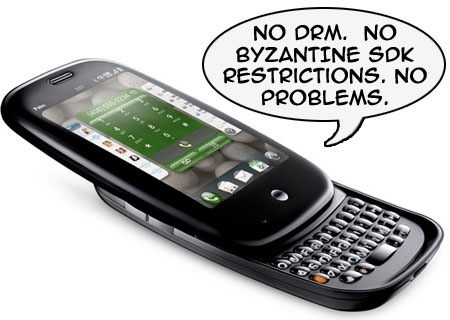
Is the Pre the Smartphone for the Rest Of Us?…wait…that’s not right…
As if there was ever any doubt, Palm has announced that they will in fact be providing an online application retail outlet for the new WebOS-powered Palm Pre, which they have dubbed the “App Catalogue.” The fact that this was coming was essentially a no-brainer, but the big question is, does Palm intend the Catalogue to be a walled-garden-type store from which all Pre owners must purchase software, or will it be simply an available option, leaving users free to install-at-their-own-risk an application they find from a source outside the store?
My money’s on the former, but I’m hoping for the latter. I’m not saying this based on any preconception offered by Palm’s practices in the past; simply that Ed Colligan seems like the type of CEO who would look at the moneymaking bonanza that is *ahem* the competition’s walled garden app store and say “Oh HELL yes.” After all, he’s the guy who said this:
When asked if the Palm Pre’s price would be less than the iPhone’s $199, Palm CEO Ed Colligan replied, “Why would we do that when we have a significantly better product?” (Gizmodo)
Now that’s an open-palm bitchslap if ever there was one.
The Pre will be released later this year in the US on the Sprint Network. We here at rgbFilter are all pretty stoked about the Pre and what it means for the wireless landscape in general (I gotz to get me some of that Synergy), and look forward to bringing you a hands-on as soon as possible.
UPDATE via drsquid:
According to a CBC Technology story posted today, Palm’s App Catalogue will indeed be open to all.
Chief among Palm’s innovations is the decision to throw the doors wide open on its application store — a depot of downloadable software that allows users to customize their phones. While the company will offer free and certified applications, anyone who wants to design software for the Pre will be free to do so and won’t be required to seek Palm’s approval, as seen with others such as Apple.
The openness will spur innovation, Crowley said, but users will also have to be wary because there will certainly be some malicious applications distributed.
“We’re going to be a lot more open,” he said. “That’s good and bad.”
This isn’t a surprising move for anybody familiar with Palm’s history of letting developers create and distribute applications however they want. That combined with using Amazon’s DRM free MP3 store (at least in the US) suggests that the philosophy of simple and openness that Palm has held since day one is still holding true.
It would be nice to see an open catalogue, working as a central repository, but not with the type of veto power Apple has over their App Store. Factors I think in favour of it being (at least somewhat) open…
-Palms current market position (openness would be good press)
-Palms decade history of letting devs make what they want.
On the flip side, total control can be a real cash cow.
Personally, I’d love to see the Catalogue working as a central repository of EVERYTHING, with two major forks – the ‘approved & tested’ as well as the ‘not so much’. There should be no preferential treatment of the presentation of the ‘approved’ apps.
Beyond the Catalogue (which I will from now on call the App Cat), devs should still be able to distribute their apps however they want outside the App Cat environment.
So long as apple has the plethora of 3rd party accessories that the iphone enjoys its still their game… being said this phone looks hot!
Meh, Apple can remain the big boy in terms of volume; I don’t care much about that. All I care about is whether Palm is going to lock down their App Cat (:P) in the same arbitrary, Orwellian, blacklist-trigger-happy fashion.
I *MAY* stray from Apple for this one..we’ll see how it performs in the wild. I *REEEALLY* like this phone. That said, Palm never played well with Macs, and I don;t relish the thought of booting into XP every time I wanna sync my calendar…
If you’re worried about booting into XP to sync your calander, then I think you’re missing the real point of Synergy. 🙂
BTW, came across info on the Pre’s processor. It’s the OMAP 3430. Two years ago, they were running demos of it with clock speeds of 1Ghz.
http://focus.ti.com/general/docs/wtbu/wtbuproductcontent.tsp?templateId=6123&navigationId=12643&contentId=14649
Hmmm….
Heh, well there’s THAT…but if I choose no to use the cloud and just want to stay local…you get what I’m saying 😛
They did mention Outlook and Exchange support. Not sure about Mac apps, but it’s not surprising since Palm would want the enterprise demographic that has stuck with them to be assured that things will get better.
Even with ‘cloud’ contacts/calendars, you’re not forever tied to the cloud. You still have to sync once, but they’re using HTML 5 standards, which will allow them to locally store your data from any of the web based services.
My understanding is that you can manipulate that data locally, and when you connect again, it will be synced with the remote server using HTML 5 local storage technology (something I never heard of until reading about it on the Pre).
BTW, the gadget crowd seem really enamoured with the Pre so far. Its hype factor seems somewhere between the iPhone and Android.
I found more info about the processor and wanted to do a post, but was worried about this getting as ridiculous as the iPhone pre-launch hype. 🙂
Honestly, this is the first device to come along that could actually knock the iPhone off its false-idol-status perch. This one is worth talking about, IMHO.
1 GHZ?!!? GTFO…
BTW, iPhone 3.0 is in beta (or soon will be)…I wonder what new treasures it will bring, and how it will compare to the Pre…or even if it WILL compare…
Yeah, the chip sounds pretty impressive, and apparently does a lot to reduce power consumption. If it’s capable of running at 1Ghz, then their claim of ‘laptop’ performance isn’t too far off the mark.
It has some pretty advanced graphics capabilities too, from able to capture 720×480 30fps video, to OpenGL ES 2.0 support, though Palm’s certainly not touting that aspect of the Pre.
If the chip is that capable, it’ll only make demands for the FULL SDK even higher.
They were raving about it on stern this morning…
The Pre or 3.0?
sorry
pre
Chief among Palm’s innovations is the decision to throw the doors wide open on its application store — a depot of downloadable software that allows users to customize their phones. While the company will offer free and certified applications, anyone who wants to design software for the Pre will be free to do so and won’t be required to seek Palm’s approval, as seen with others such as Apple.
The openness will spur innovation, Crowley said, but users will also have to be wary because there will certainly be some malicious applications distributed.
“We’re going to be a lot more open,” he said. “That’s good and bad.”
from
http://www.cbc.ca/technology/story/2009/01/12/tech-ces-roundup.html
Well, at least now the walled garden speculation is over.
I think it’s time for Ryan to update his post with the CBC info.
This is my favourite thing about the Palm Pre so far – presuming it isn’t bullshit. I am concerned with the phrasing ‘a lot more open’. Open is open – it shouldn’t be a matter of degree. Hopefully, he just chose his words poorly and really will be open, as in open-type open.
Although not entirely clear, it sounds like they’re gonna use the model I mentioned earlier in this thread.
Almost Pre-cognitive on my part, no? Yes. I went there. 🙂
Seriously though, the idea of having a ‘certified’ tag in the App Cat that the end user can trust, while not restricting devs who want go their own route is really the best model.
As a long time smart phone user, of just about every OS, it’s not surprising to me that Palm would take this hybrid model, including freedom FROM the App Cat, because this freedom helped build the Palm ecosystem. The estimated number of apps available for the old Palm OS is somewhere north of 50,000. It just lacked a central place where both devs and end users could feel comfortable knowing they’re getting a comprehensive choice.
In the past, Palm (and WinMo) users depended on 3rd party web stores. Since the web stores weren’t maintained by the OS maker, they could do whatever they want, leading devs and users to switch between multiple vendors, as each of the majors, Handango and Pocketgear both stirred up developer ire at different points in their history.
The only worrisome question I can see is “What does it take to get the certified classification?” Will it be based solely on stability, or will they pull an Apple when it comes to what they deem ‘adult content’, as we’ve seen from App Store bannings?
i never even thought for one minute – it never even occurred for me to think about it, that the Palm app store or what ever would be gated, since Palm, like Microsoft has always allowed open application development for their platforms – why would they suddenly change that and follow apple’s model ? Only Jobs is arrogant enough to think that this is a viable model – though I must admit it has probably been quite sucessfull for them
It is in fact a viable model – that’s unfortunately been proven. I have even been asked to help co-develop an iPhone app, people get so excited the App Store, all other considerations are just shrugged off. Nothing evil can be this popular, right? So it’s clearly viable. It’s just unethical. (Yes I refused to throw my oar in.)
PAUL, I just noticed the stones in the Pre’s wallpaper…think that might be a backhand punk-off to the Cupertinos? (I’m sure you remember the rocks & stones stock wallpaper that shipped with Tiger :P)
Totally. XD
From what I have read in other articles Palm will have some kind of mechanism to screen for malicious code in apps though – security is supposed to be the only area that they might deny/remove some apps
I’m sure that’ll be put to the test once the inevitable fully illustrated Kama Sutra app gets made for the Pre. 😀
I’ll be surprised if they don’t also screen out hardcore porn. I think this might be why they carefully said ‘a lot more open’ rather than ‘totally open’. Of course, there should also be a way of distributing apps outside of the App Catalog – right?
Of course. It clear from the article (assuming they’re right) that developers can completely bypass the App Cat for program distribution….
So even if Palm does want to ‘keep it clean’ in the App Cat, developers won’t be left in the dark.
If only there were a way to build a time machine using modern materials, and show people a world completely based on Apple’s distribution model, versus Palm’s, or somehow make clear to them what kind of world what they are supporting could lead to.
And if only the Pre were a little bit thinner. I prefer the iPhone’s form factor, and I am bewildered at the need for a physical keyboard, as if those tiny little keys are somehow going to make life easier. (As you know I can’t stand those wee little keyboards and would likely never spend money on one. The fact that it makes the phone so much fatter for the sake of a feature I detest is extra irksome. The software looks quite good though but I question the need for a separate gestural surface from the actual screen. Simplify, people! Finger smudges are really no big deal to justify that much interface complication.)
Amen to the time machine.
From the CES coverage, it sounds like they will be coming out with other form factors at some point. Keyboard vs dimensions is always a trade off. A good portrait keyboard will always be faster than on screen, and a well-designed landscape keyboard is faster than a portrait one, but the need/desire for one form factor over another will always be personal preference.
Although I could live without the keyboard, ‘fatter’ is a relative term. It’s only marginally thicker than my HTC Touch and has a smaller footprint, to the point where it’s probably around the same volume.
It’s not surprising that the touch area extends beyond the screen, either. It’s a modern interpretation of the old Palm Graffiti area. Beyond the ‘smudge’ factor, being able to touch the area below the screen to enable copy/paste is its own reward (thumb below the screen, another finger/thumb to highlight the text). 🙂
Personally, I like the kbrd, as far as phone boards go…the keys are nicely spaced out and “jewelly”, as opposed to the flat, hard-bevelled keys on the Bold or the Curve. Still no Touch Pro, tho 🙂
As Doug rightly pointed out, the lack/presence of a physical keyboard is a matter of personal preference. I, personally, now prefer the softboard, but that was not the case when I got the phone…there was a learning curve. I STILL feel that softboards work best on Capacitive screens, though, which means I would likely like a softboard on the Pre. If there are oher form factors coming, I wouldn’t be entirely surprised if they did away with teh Hardboard altogether in one version, or at least build it in to the OS on all versions.
I disagree with Paul tho that the phone is too “fat”…as far as I can tell, it’s the perfect “thickness”…about as thick as my iPhone is with a case on it (which adds about 10-15% in depth). And as the diagram in our OTHER post indicates, its footprint is significantly smalle than the iPhone’s, so if anything it will be MORE portable.
Beyond all that, I think getting hung up on how fat a deice is that still only measures ~.5 inches is POINT-LESS, especially one such as this that could concievably do away with the need to carry a laptop to meetings to check e-mail, take notes, etc etc etc. Hell, if they build a projector into it (one day…sigh…), it could be your portable Powerpoint presentation device 🙂 I’d accept a phone that’s .75” for that 🙂
This is all about preferences. I fail to see why mine are any more ‘personal’ than anyone else’s. Also, why are my objections ‘hang-ups’. I am not getting ‘hung up’ on anything, I’m just stating what isn’t optimal, that’s kind of what we do around here. Just because I don’t like what Apple has done with the iPhone App Store, doesn’t mean I’m going to crawl up Palm’s derriere. The fact is, tiny chiclet keyboards suck and everybody knows it, and some people are just willing to live with it. I think they are bad enough that they are not worth the physical space required to create them and are not long for this world. In fact I’m willing to bet that Palm’s next iteration on this product line will include one without it. They are trying very hard to differentiate from the iPhone right now and address common iPhone criticisms. But I think the resistance to dropping tiny little keyboards is all in people’s heads — particularly the portrait ones — and the market will eventually work this stuff out. A landscape physical keyboard is something I would at least keep an open mind about but it would have to make typing pretty damn fast for me to think there would be a point to it.
As for the thickness … why are you comparing it to another phone *with a case on it*? Don’t you think people will put the Pre in a case? Also, cel phones aren’t used on a surface so ‘footprint’ is fairly irrelevant. As long as they fit in a pocket, it’s the thickness that counts.
And there is no way I would ever use that tiny a keyboard to take notes in any kind of meeting. Let’s get real: the keyboard sucks, all tiny keyboards like that suck. I doubt I would take meeting notes with the iPhone, either, but at least it hasn’t wasted physical space and made itself way thicker, so that I can do something that I’m not going to do.
…did you quit smoking again?
…are you not getting laid again? 😛
…must…ignore…obvious…rebuttal…
You’ve missed my point. I’m not the one who dragged personal accusations into this.
Jokes man 🙂 Thought your post was a little more forceful than usual, that’s all.
But yeah, I missed your point completely, although I would hardly call that a “personal accusation”. Anyway, sorry.
No worries. And you’re right. It was ad hominem is what I should have said, rather than ‘accusation’. BTW the answer to the ‘did you’ is no.
I’m trying to think of anyone I know with a slider phone that has a case on it…coming up empty. Cases for sliders are pretty impractical, no? Regardless, I made the comparison with my phone with a case and Palm without one for that reason…I don;t see people putting a case on this thing. But they probably will…who knows.
Why bother to even put a case on the iPhone, and why doesn’t whatever logic you would have for doing that, also apply to the Pre?
I only don;t think ppl will put the PRE ina case because I don’t think cases for sliders are very practical. (i.e. I wouldn’t.)
Take for instance these cases for the TOUCH PRO: http://pdabreak.com/2008/htc-touch-pro-cases/
They’re a pain in the ass. Unbotton & open a case before being able to open the slider…what a PITA.
My phone is in a case because, not having a slider, it’s NOT a PITA and it keeps the shiny plastic back from getting all hacked to hell when I carry it around or when I skip it across the desk when I dump my crap out on my desk 🙂
I guess if you have a Pre then you have no choice but to let it get all hacked to hell?
I personally wouldn’t buy a case for either one.
Fucking über-intellectuals man…come on down to my level, everything’s much more chill.
You haven’t seemed very chill to me with all the all-caps yelling of your key points. I don’t get why you’ve been heating up this thread and then accusing me of do it. Anyway, I still don’t get why it’s ok to scratch up your Pre but not your iPhone, but my opinions are obviously getting up your nose so let’s just call this one off.
?!? No man, I just don’t think you’re getting my point.
Anyway, the deletions have begun, so ya, this is a wash 🙂
I get that a Pre case is more difficult to make work, if that’s what you mean by my not getting it. I just don’t think it’s fair to compare caseless with caseful, since I have the option of not having a case in either … uh, case. 🙂
P.S. Deletions? Who is deleting things?
Oh maybe not…maybe I didn’t hit *SUBMIT* on the one I’m thinking of 🙂
Stupid work is getting in the way of my interwebz…
Maybe I should be glad you didn’t submit and school me further, lol. Go back to work! 😀
DON’T TELL ME HOW TO LIVE MY LIFE!!!!
Too bad too, it was the most iron-clad, brilliant, inarguable post there ever was…there were charts, expert opinions, a Unicorn…it was amazing.
And the world will never know 🙁
I like how the phone look’s like it’s got a mighty big grin on its face in the graphic at the top. 😀
Ha! I actually thought of playing that ‘grinning face’ thing up. It’s the main reason I went with the comic ballon, but decided to leave it be.
Glad my lack of effort hasn’t gone unnoticed… erhm… or something like that! 😉
Looks like there is a reply level limit. Anyway… @Doug … achieving the same volume with a thicker body but a smaller screen seems like a dead stupid trade-off to me, since nobody values thickness but everybody values screensize. And Palm needs to abandon their old Graffiti ways and if they can’t figure out how to implement copy-and-paste without a whole separate touch area then maybe Jon Rubinstein took a little too much of the RDF with him! 😀
Does it come with a stylus? Will it run old Palm Graffiti-based apps? Seems to me probably not so why bother with the separate touch area.
Have you watched the vids? The Touch Area is seperate so you can call up other apps or otherwise navigate the phone without putting your finger on the main screen, i.e. obscuring your view of what you;re doing (à-la the HTC Diamond’s Playstation-style menubar). I think Doug’s comparing it to how the Graffiti area was not part of the main screen on Palm’s old PDAs (although it evolved to be in-window in later versions of the Tungsten), and that this “touchbar” area (what’s it called?) is reminiscent of that UI separation.
No stylus (capacitive screen, and the device appears to have no holding port for one),and all indications are that the new OS will not support older PALM apps…which, considering Palm as taking a “fresh start” approach with this device/OS, neither surprises nor concerns me. I would imagine, however, there will be new and updated versions of the core apps, and since the OS is JAVA based, exporting settings/contacts from an older PALM device will likely not be much of a headache.
I watched some of the vids. None of those ‘touchbar’ things seem particularly necessary to me. Do tablet PCs have a separate touchbar area to keep your hand from supposedly blocking your view, has anybody bothered with that? That strikes me as the least convincing ‘plus’ (and I’ve seen it out there before in other discussions about the Pre).
That all being said, I genuinely hope that the Palm Pre is very successful and rivals the iPhone, but I’m not willing to become a pure cheerleader just to achieve that, I’m going to call out the choices that were made that don’t really work for me, as everyone should.
Basically, I think Apple has done everything right with the iPhone, except for their obsession with controlling how you use it. If it weren’t for the bad taste that this obsession leaves in my mouth, I would be saving up for an iPhone (or probably an iPod touch) right now.
Oh yeah no-copy-and-paste, that was definitely questionable, but beyond that the iPhone UI still looks tops to me.
It’s funny you say that…because even though I think I might prefer the PRE right now, my MAC life (by which I mean every computer I have at home and work is a MAC) means I’ll DEFINITELY be buying the iPhone rev3 henver it gets released…with its multi-core Proc 😀
Dimensions, like screen size and keyboard options, are personal preference.
I know people who want nothing but landscape keyboards. I know others who prefer the Treo/Pre style chicklets, and obviously there are supporters of on screen only. I’ve used just about every form factor (PDA or phone) out there, and can only speak for myself, but..
The elusive portrait QWERTY slider is part of the reason I’m looking forward to at least trying out the Pre in store. Historically portrait sliders have been (mostly) numeric keypads a la the HTC Touch Dual, and there was a time when that was announced I kind of wished it was a QWERTY slider. Though fast enough on screen I miss a real keyboard, portrait or landscape. Unfortunately, portrait keyboards are generally below the screen Blackberry/Treo style, meaning a sacrifice of either screen size or pocketability.
The only portrait QWERTY in a slider I can think of was the HTC Harrier (I think there may have been one or two others, but don’t recall names), which I was considering unlocked around the time I got my HTC Wizard, but the lure of a bigger keyboard (and the abysmal design of the Harrier’s keybaord) swayed me. I had just come off of using a Treo 650 for about a month, and heard bad things in comparison.
I also think that the physical screen size is well nigh perfect. I remember talking with Ryan about a week after he got his iPhone, and saying I wish somebody would make a phone with a screen of basically that exact dimension. As someone who does just about everything except text editing on his phone with his left thumb, the Pres dimensions means there’ll be no need to reposition the phone in hand to reach every corner of the screen and every key.
As for the separate area being NEEDED for copy/paste, as opposed to one implementation, I can’t say as it was only referenced as “one way to…”, so I’m not sure how much Ye Old Field Of Distortion comes into it.
So, in short, from a purely hardware POV, this is the one form factor I’ve been wanting to see for some time in a smartphone.
I hope the OS lives up to what the CES keynote suggests.
The Pre is certainly awakening a lot of latent fanboyism though (and I’m included in that group) for sure.
I think just about every long time smart phone and PDA user is rooting for Palm in a “Hope for the best, expect the worst” kind of way.
[…] change of heart regarding the App Store comes hot on the heels of Palm’s announcement of the App Catalogue (or App Cat) for the upcoming WebOS-based Palm Pre, which Palm has said “will offer free and […]
[…] Links: Palm Pre info Important Windows Key Shortcuts Feedburner Issues Glad i’m not on Feedburner Feed Squeezer? Kodax ZX1 […]