
Net Neutrality Perfect Storm, eh! – Updated

For some time, net neutrality has been below the radar for most Canadians. Sure, we’ve read about what’s going on in the US, but many of the regulations governing internet backbones and content delivery are different up here. For example, Canadian law charges a piracy tax on writeable media such as CDs, to offset piracy.
In the past couple of weeks we’ve seen a perfect storm brewing regarding net neutrality in our home and native land. Here’s a quick breakdown…
Bell Canada is required to sell DSL lines wholesale to resellers at a regulated price, as dictated by the CRTC (Canadian Radio-television and Telecommunications Commission). In turn, the 3rd party resellers set their own prices for end users, based on their own administrative policies. One reseller would, for example, offer a flat monthly rate, but the end user could opt between unlimited bandwidth with a 15 millisecond delay per packet, or 200GB with no delay. Another reseller could offer varying rates based on usage.
In the past couple of weeks, Bell announced it would be doing packet-shaping not only for it’s own Sympatico DSL subscribers, but also on the wholesale level. By early to mid April, DSL subscribers in Canada will see a major slowdown in any torrent activity, regardless of their provider.
What makes this more interesting is the recent announcement by the CBC (Canadian Broadcasting Corporation) to distribute Canada’s Next Great Prime Minister via bit torrent, using mininova.org to announce. Many people who have tried to download Canada’s Next Great Prime Minister have already reported issues with speed, because of Bell’s new packet shaping policy. The CBC is a gov’t funded broadcaster, and one of it’s mandates is to deliver content to Canadians in the most efficient manner possible. Bell Canada is interfering with the CBC’s ability to get content to Canadian citizens.
What makes this an even stickier wicket for Bell is that they also run Canada’s largest satellite television company, Bell Express Vu. This sets up another conflict of interest between a private sector broadcaster, and tax dollar supported programming.
This isn’t just about broadcasters though. Bit torrent is a technology that IS largely used for pirating TV shows. To deny that would be to deny reality. At the same time it’s also used by millions to legally distribute open source software such as Linux and Open Office, game demos, and a large number of audio and video podcasts.
I suspect that there’s a storm abrewing.
UPDATE: I came across this info from the DSL Reports forum, posted by 3rd party DSL provider TekSavvy. It illustrates the effect Bell’s throttling is having on customers. Apparently it’s affecting more than just P2P. It’s worth pointing out that the charts below represent a stacked chart.
Here are the charts… hit the link to see them full size.
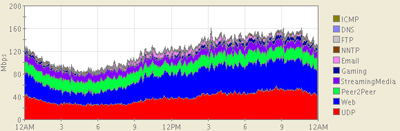
before throttling and…
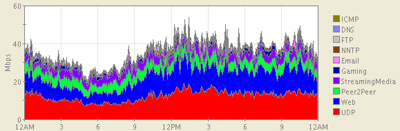
The charts also show another factual ‘misrepresentation’ that we hear from not only from Bell Sympatico, but from most major carriers in North America. That P2P is eating up the bandwidth. When looking at the stacked chart, it’s clear that Web traffic combined with streaming is double that of P2P traffic. Here’s an excerpt from packet shaping company Ellacoya’s June 2007 “Media Alert” pdf released during the NXTComm Show in Chicago…
After more than four years during which peer-to-peer (P2P) applications have overwhelmingly consumed
the largest percentage of bandwidth on the network, HTTP (Web) traffic has overtaken P2P and continues
to grow. Presently, as a result of streaming audio and video in Web downloads, HTTP is approximately
46% of all traffic on the network. P2P continues as a strong second place at 37% of total traffic.
Newsgroups (9%), non-HTTP video streaming (3%), gaming (2%) and VoIP (1%) are the next widely used
applications.Breaking down application types within HTTP, the data reveals that traditional Web page downloads (i.e.
text and images) represent 45% of all Web traffic. Streaming video represents 36% and streaming audio
5% of all HTTP traffic. YouTube alone comprises approximately 20% of all HTTP traffic, or nearly 10% of
all traffic on the Internet.
It should also be pointed out that Bell (through it’s BCE Capital division) became a major investor of Ellacoya. This isn’t to say that there’s anything wrong with Ellacoya, or Bell investing in them. By throttling streaming media and web services of 3rd party suppliers, Bell is making their own services more appealing.



I wish to express appreciation to this writer just for rescuing me from this type of scenario. After exploring through the internet and obtaining recommendations that were not helpful, I was thinking my entire life was over. Living devoid of the approaches to the problems you have sorted out as a result of your main article is a crucial case, as well as the ones which may have in a wrong way damaged my entire career if I had not encountered your blog. Your own training and kindness in taking care of all the pieces was valuable. I am not sure what I would’ve done if I hadn’t come upon such a point like this. I can also at this moment look forward to my future. Thanks for your time so much for this reliable and sensible guide. I will not think twice to recommend your site to any individual who needs guidelines on this matter.
plaquenil tablets
viagra prescription online usa
Hello would you mind letting me know which webhost you’re
utilizing? I’ve loaded your blog in 3 different internet browsers and I must say
this blog loads a lot faster then most. Can you recommend a good internet hosting provider at a
reasonable price? Kudos, I appreciate it!
citalopram 10mg generic
My brother suggested I would possibly like this website.
He used to be totally right. This post actually made my
day. You cann’t consider simply how much time I had spent for this information! Thank
you!
orlistat hexal
sildenafil 20 mg tablets coupon
I wanted to send a simple word to be able to express gratitude to you for the fabulous suggestions you are giving out at this website. My time-consuming internet research has finally been honored with good quality ideas to exchange with my friends. I would state that that many of us site visitors are undoubtedly endowed to live in a useful website with so many wonderful professionals with interesting techniques. I feel truly fortunate to have seen your entire webpages and look forward to really more amazing moments reading here. Thanks once again for a lot of things.
I really wanted to post a quick word to express gratitude to you for those precious advice you are giving on this site. My long internet research has at the end of the day been rewarded with really good strategies to write about with my family. I would assert that we site visitors actually are quite fortunate to dwell in a fabulous community with very many marvellous individuals with insightful methods. I feel somewhat blessed to have come across the weblog and look forward to plenty of more entertaining moments reading here. Thank you again for everything.
I must express appreciation to this writer just for rescuing me from this challenge. Just after looking throughout the search engines and finding opinions which are not pleasant, I believed my entire life was well over. Existing without the presence of solutions to the difficulties you’ve resolved as a result of your main website is a crucial case, and ones which might have in a wrong way affected my career if I hadn’t noticed your web page. Your mastery and kindness in controlling everything was useful. I’m not sure what I would have done if I hadn’t encountered such a solution like this. I am able to at this time relish my future. Thanks so much for the impressive and results-oriented guide. I won’t be reluctant to endorse your blog to anyone who would like guidelines about this area.
I’m writing to let you know what a helpful experience our girl went through going through yuor web blog. She realized a wide variety of details, not to mention what it’s like to possess a very effective giving mood to make others easily know just exactly some grueling subject matter. You undoubtedly exceeded her desires. Thank you for churning out the essential, healthy, educational and as well as easy guidance on this topic to Sandra.
acyclovir dosage 800mg https://www.herpessymptomsinmen.org/productacyclovir/
motrin cream
is viagra a prescription drug https://buszcentrum.com/
when will lumigan become generic https://carepro1st.com/
I as well as my pals came analyzing the nice guidelines located on your web page while all of a sudden I got a terrible suspicion I never thanked the website owner for those strategies. All the men happened to be so passionate to read all of them and have now unquestionably been having fun with these things. Thanks for really being so helpful and also for pick out certain superior ideas millions of individuals are really needing to discover. My very own honest apologies for not expressing appreciation to earlier.
Thank you for all of the labor on this web page. My aunt delights in getting into internet research and it’s really obvious why. A number of us hear all of the lively way you render simple ideas on the web blog and even boost participation from website visitors about this matter plus our favorite girl is really being taught a great deal. Have fun with the remaining portion of the year. You are always performing a remarkable job.
I actually wanted to write a small remark to appreciate you for all the remarkable steps you are giving out on this website. My time consuming internet lookup has at the end been compensated with pleasant tips to exchange with my friends and family. I would admit that most of us visitors are unquestionably fortunate to live in a remarkable community with so many special professionals with very helpful plans. I feel very privileged to have discovered the site and look forward to so many more thrilling times reading here. Thank you again for all the details.
I just wanted to post a note to be able to say thanks to you for the lovely concepts you are posting on this site. My rather long internet search has finally been paid with extremely good content to talk about with my great friends. I would assert that most of us readers actually are rather blessed to dwell in a perfect site with many marvellous people with beneficial basics. I feel pretty blessed to have discovered your entire website page and look forward to so many more awesome times reading here. Thanks once more for all the details.
I would like to point out my love for your generosity supporting folks that absolutely need help on this particular subject matter. Your real dedication to getting the message around had become certainly beneficial and has surely enabled somebody like me to realize their targets. Your entire insightful report entails this much a person like me and even more to my office colleagues. Thank you; from everyone of us.
chloroquine phosphate 500 mg 7 tablets
erectile stimulation treatment new ed drugs is erectile dysfunction mental
average cost of femara
was hydroxychloroquine over the counter https://www.herpessymptomsinmen.org/where-to-buy-hydroxychloroquine/
chloroquine over the counter usa https://azhydroxychloroquine.com/
where can i buy hydroxychloroquine online https://chloroquine1st.com/
I simply wanted to make a simple note in order to say thanks to you for all the superb guides you are placing at this website. My extensive internet research has finally been rewarded with wonderful insight to write about with my friends and classmates. I ‘d mention that many of us site visitors actually are really lucky to exist in a perfect place with so many outstanding professionals with helpful opinions. I feel very much grateful to have seen the web page and look forward to some more fun moments reading here. Thanks once more for a lot of things.
cialis w o a prescription http://www.lm360.us/
I must voice my admiration for your kindness giving support to men and women that must have guidance on this particular area. Your personal commitment to passing the solution up and down had been unbelievably interesting and has all the time empowered women just like me to reach their endeavors. Your new warm and friendly tutorial means this much to me and a whole lot more to my office colleagues. Best wishes; from each one of us.
I would like to express thanks to you for rescuing me from such a instance. Because of exploring throughout the the net and obtaining basics which are not beneficial, I was thinking my entire life was over. Living minus the strategies to the difficulties you’ve resolved all through this blog post is a crucial case, as well as the kind which may have negatively affected my career if I had not come across your blog post. That mastery and kindness in touching all the stuff was excellent. I don’t know what I would’ve done if I had not come upon such a subject like this. I can also at this time look forward to my future. Thanks a lot so much for your specialized and result oriented guide. I will not hesitate to suggest your web blog to anybody who needs and wants guidance about this issue.
I would like to show appreciation to the writer for bailing me out of this situation. Because of scouting throughout the internet and finding principles that were not productive, I assumed my entire life was done. Existing minus the approaches to the problems you’ve solved all through your entire guideline is a critical case, and ones which could have adversely damaged my career if I hadn’t encountered your blog. Your main mastery and kindness in dealing with a lot of things was helpful. I don’t know what I would have done if I had not come upon such a solution like this. It’s possible to at this time look forward to my future. Thank you very much for your professional and effective help. I won’t think twice to endorse the sites to anybody who desires guidance about this situation.
erectile function score best erectile dysfunction drug erectile enhancement supplements
generic viagra no pres http://grassfed.us/
Hello! I know this is somewhat off topic but I was wondering which
blog platform are you using for this website?
I’m getting fed up of WordPress because I’ve had problems with hackers and I’m
looking at options for another platform. I would be fantastic if you
could point me in the direction of a good platform.
I just couldn’t leave your website before suggesting that I actually enjoyed the usual information a person supply to your guests?
Is going to be again ceaselessly in order to check out new posts